A SHORT RECKONING
BRYAN ORTON
THE FIRST LITERACY
The one thing school never taught you— how to read the story you’ve been living inside
BY BRYAN ORTON
This is yours. Read it, use it, and—if it does something for you—pass it on. Post it, print it, text it, email it to one person who needs it.
All I ask is that you don’t change it and don’t claim you wrote it
ONE
A Student Named Tim
Fall of 2010. My alternative-education classroom, where many believe schools send the kids they have mostly stopped expecting things from.
A high school junior named Tim walked in on the first day, dropped into a chair in the back, and folded his arms across his chest. He didn’t say a word. He didn’t have to. The whole posture said it: you can’t touch me. I’m not letting you in. Screw off.
I’d seen it before. You don’t last long in rooms like that without learning to read it. And here’s the first thing years of teaching taught me: that posture is never defiance. It’s armor. Nobody puts on armor that heavy unless something underneath it has already been hurt more times than a kid should have to count.
Tim had a particular problem with teachers. In his experience, a teacher was a person who found the thing that was wrong with you and held it up to the light. He’d been corrected, scolded, red-penned, and diagnosed so many times that he’d done the efficient thing—he’d beaten everyone to the punch. Ask him who he was and he’d tell you flat out, no flinch: an arrogant, ignorant little asshole.
He said it like a fact. Like a young man reading his own rap sheet.
That is what a label does once you’ve worn it long enough. You stop arguing with it. You start introducing yourself with it.
His first writing assignment came in full of misspellings, half of it phonetic—the kind you have to sound out loud to decode. He wrote vary every single time he meant very. Small thing. I showed him the fix… and he took it.
That was the tell, and the door that cracked open. Because a kid who has truly given up does not bother to change vary to very. The armor said screw off. The pencil said show me—I want to learn.
Hold onto Tim. We’ll come back to him—and the last word in this whole document is going to be his, not mine.
TWO
The Curriculum Nobody Handed You
I’ve spent thirty years in classrooms. Rural high schools, alt-ed classrooms, a mental-health day-treatment program, and a federal correctional facility. All of it taught me one thing I can’t unsee: school is very good at delivering a curriculum, yet the curriculum is missing the six things that actually decide how a life goes.
Not algebra. Not the year the War of 1812 ended.
Identity — who you actually are, underneath the labels.
Meaning — what your life is for, and the kind of purpose that holds up under pressure.
Relationships — the skills that decide the quality of every relationship you’ll ever have.
Money — how it works, so it can work for you (and not against you).
Contribution — what the world needs that you happen to be built to do.
Decision — why a choice you don’t act on was never really a decision at all.
Six literacies. Life demands every one of them. School teaches none of them. I ended up writing a whole book about them—but that’s for the end of this, and only if you want it.
Because one of the six sits underneath the other five. Get it wrong and every other one comes out crooked, and you won’t be able to tell from the inside. It’s the first literacy: Identity. It’s the one I’m going to break down with you right here, on this page.
THREE
The Lens You Can’t See
Here’s the trap.
Most adults are walking around looking through a lens that was made for them by other people, a long time ago, when they were far too young to check the prescription. The labels—the smart one, the difficult one, the quiet one, the one we worry about, the arrogant little asshole. The sorting—the tracks, the reading groups, the subtle decisions grown-ups made about what you were and weren’t capable of. By the time you were eighteen, you were seeing the entire world through a lens shaped by a thousand small verdicts you never got a vote on.
The lens doesn’t feel like a lens. That’s what makes it so powerful. It feels like reality. It feels like just the way things are. It feels like who I am. Identity Literacy is the practice of noticing the lens—and then, slowly, on purpose, creating a different one.
So let me ask you the question school never did. Don’t rush it.
What were you taught to believe about yourself?
Not who you’d like to be. Who you got told you were—by a parent, a teacher, a report card, a nickname that stuck, or one moment you can still feel in your body if you go looking. What’s the label?
And now the sharper one, the one underneath it: whose voice is it in?
Because most of us are still running a program somebody else installed, and we’ve been mistaking it for our own thinking for so long we can’t hear the accent anymore.
Sit with that for a second. Get the label, and get whose voice it’s in.
That thing you just found—that’s not you. That’s a story about you. A story about you is not a fact about you. It’s just the one you’ve had the longest, so it feels normal.
FOUR
The Dropdown Menu
I know that trap from the inside. Let me turn the focus on myself, because I’m not standing above any of this.
Somewhere more than a decade before there was ever a book, I was setting up my LinkedIn profile. If you’ve ever made one, you know the drill. It asks you who you are. There’s a field with a list, and you pick one.
I stopped on that field longer than a form required you to stop.
Because I had a choice. I could put down something already true—something safe, something my history would back up. Or I could put down the thing I wanted to grow into.
I clicked Author.
I want to be honest about how untrue that was. I hadn’t written a book. I hadn’t written anything. There was no evidence anywhere that I was an author. I remember the exact feeling: this isn’t true right now. It isn’t true at all right now. But it’s what I want to become true.
Then it took me more than ten years to make that dropdown honest.
Here’s what almost everyone gets backwards about change, and why most attempts go nowhere. Most people try to change by changing their behavior. They set a goal, grind on willpower, the willpower runs out, the behavior collapses, and they decide they just don’t have the discipline. Wrong order.
You don’t change by performing a new behavior. You declare a new identity—and then you perform the behavior that flows from it.
A person who says I’m trying to write a book and a person who says I’m a writer will treat their morning completely differently. The first one waits to feel like writing. The second one sits down, because that’s what writers do. The declaration sets the frame you live within. Everything else leans that way.
And you’ve stood exactly where I stood. Everyone has filled out that field. Everyone has hit the moment where a blank space asks what do you get to call yourself. Most people pick the answer that’s already true and safe. The move—the whole move—is to pick the one you’re growing toward, and then spend the next stretch of your life creating the evidence.
What I really claimed at that dropdown wasn’t “writer.” Underneath it was something bigger: my voice is worth something. A kid who’d spent years being told to sit down and be quiet decided he had something worth saying. The writing was just the vehicle.
The next time some app or form asks who you are, you’ll feel the flinch. Click the one you’re becoming.
FIVE
Declaring Is the Easy Part
Here’s where I have to uncover more for you, because if I stop at the dropdown I’ve sold you a feeling instead of the truth.
Clicking Author did not make me an author. It made me a man with a claim and no proof—and reality took its sweet, brutal time catching up. A declaration with nothing behind it collapses right back into the old story. This is where nearly everyone loses. They have the moment—the crack of light where they see the lens for what it is—and then Monday comes, and the old lens is right back on their face. A declaration is powerful and necessary, but it’s only a moment in time. A great life is built out of the days that follow that crucial declaration.
I know how far the old story can reach, because mine wasn’t shyness. It was anger.
Growing up, people saw me as funny, quiet, or invisible. It really depended on the situation and the people. I liked church and the people there, so I had no reason to show another side of me. But I did have another, dramatically different side, like the Hulk. If I got disrespected in a mean way, pushed around as if I were helpless, or cornered with no escape—if I got really frustrated—my temper could boil over. One trigger was being handed a book or article and told to read it out loud. I’d feel the tension rise fast, and the anger came up out of me like a dam that broke.
I was sixteen. I’d just finished restoring my first car, a 1978 Plymouth Fury. I’d thoroughly cleaned the interior, had a stereo installed, gotten the engine tuned, and —what I was most proud of—had it painted in the back of my dad’s airplane maintenance shop, blue, with metallic flake in it. I was as proud of that car as I’d ever been of anything.
One night I drove it to pick up my sister where she worked. While I waited, a car pulled up beside me, and the passenger threw open their door hard enough to slam it into my car and chip the paint I’d spent hours sanding, preparing, and waxing.
My blood pressure went through the roof. But I walked over and I did the right thing first. I asked the driver if we could trade insurance information. Or if he’d make it right somehow.
He said no.
The dam broke. I lost it. I went at that car with everything I had. They started to pull away—and I wasn’t going to let them. My foot went for the gas—
Suddenly, in the rearview mirror I saw my sister’s face. Screaming one word.
STOP
That gave me just enough time to back off.
I want you to slow down right there, because that half-second is the most important part of this section. Not the anger. The gap. The sliver of space between what happened to me and what I did next.
Viktor Frankl—a man who survived the World War II concentration camps and had every right to a ruined life—put it better than I can: between stimulus and response, there is a space, and in that space is your power to choose your response. That night, the space wasn’t mine. It was an accident. My sister’s voice pried it open for me.
What changed my life was a man named Bill Wetzel, who spent years teaching me to open that space on purpose—to get in there myself, before the outburst, before the gas pedal. He’d ask it plain: Do you want anger in charge? Do you want other people’s worst moments to run you? Or do you want to be in charge of yourself? Because if anger’s in charge, then either the anger or the other guy owns you. There’s no third option.
I am in charge of myself.
Not a wish. A declaration—the same move as the dropdown, made on far harder ground. I had to make it, and remake it, and back it with a thousand small choices in a thousand small gaps, until one day it wasn’t something I was fighting. It was just who I am.
That’s the follow-through. That’s the whole ball game. The declaration is the ignition. The thing that keeps the engine running after the room goes quiet—the small action that generates real evidence, the evidence that finally rewrites the belief, the belief that hardens into identity—that’s the work I spent years building into a system. I got tired of watching people have the breakthrough and then lose it soon after. I call it the Infinity Shift System. More on that at the end, too, if you want it.
For now, just take the thing that’s free and true: you have a gap. You’ve always had it. Nobody taught you to find it. But you can start today.
SIX
The Only Curriculum That Has Ever Worked
Bill had a one-word answer for anyone who asked him how do I actually change. The word was HOW, and it was an acronym.
Honest. Be honest about where you actually are—not where you wish you were, not where you tell people you are. Where you actually are.
Open. Be open to the way out not looking like what you pictured. Your next teacher might be a person you’d never have predicted, a tool you’ve been suspicious of, or a conversation you’ve been avoiding for years.
Willing. Actually do the work. Not think about it. Not plan it. Do it.
Honest, Open, Willing. It’s the only curriculum that has ever worked, for any human being, in any era, no matter what school did or didn’t teach them.
WHERE TO GO FROM HERE
TWO DOORS
If something cracked open while you were reading this, you just felt one of the six literacies work on you. Identity—the first one, the one underneath the other five. That was one.
There are two places to go from here, and you can take either, both, or neither
The other five literacies are in the book.
Identity is the deepest, but it isn’t the only thing school skipped. Meaning, relationships, money, contribution, decision—the whole missing curriculum is in The Wrong Lane: The Six Literacies School Never Taught You (But Life Demands). If you want the rest of the map, that’s where it is.
The method for making a declaration hold is the Infinity Shift System.
So it doesn’t collapse in a week. If you’ve had the moment before and watched it fade, this is the work that makes the next one stick: the gap, the small action, the evidence, the belief, and the new identity. That’s what I built for exactly the place where most people give up.
But understand—none of that is the point of this document. The point is the question I asked you back a few pages: who did you get told you were, and whose voice is it in. And the one right behind it: now that you can see the lens—what do you declare instead? School will never ask you that. Life is going to demand it anyway
SEVEN
Tim Gets the Last Word
I told you we’d come back to Tim.
I had him for two years. The first year, the shell cracked. The second year, the change was something to see. He graduated. He went on to rebuild his life more profoundly than I had any right to expect. It didn’t start with a lesson plan. It started with a kid discovering that this classroom was different—that the teacher wasn’t perfect either, was still working on his own stuff, and wasn’t there to find what was wrong with him.
At the end of that first year, I gave the class a reflection to write. Here is part of what Tim turned in. I’ve kept this paper for fifteen years. I’m giving it to you exactly as he wrote it—spelling and all—because the raw version is the whole truth of it, and because I want you to see the distance a person can travel from where they start:
But understand—none of that is the point of this document. The point is the question I asked you back a few pages: who did you get told you were, and whose voice is it in. And the one right behind it: now that you can see the lens—what do you declare instead? School will never ask you that. Life is going to demand it anyway
SEVEN
Tim Gets the Last Word
I told you we’d come back to Tim.
I had him for two years. The first year, the shell cracked. The second year, the change was something to see. He graduated. He went on to rebuild his life more profoundly than I had any right to expect. It didn’t start with a lesson plan. It started with a kid discovering that this classroom was different—that the teacher wasn’t perfect either, was still working on his own stuff, and wasn’t there to find what was wrong with him.
At the end of that first year, I gave the class a reflection to write. Here is part of what Tim turned in. I’ve kept this paper for fifteen years. I’m giving it to you exactly as he wrote it—spelling and all—because the raw version is the whole truth of it, and because I want you to see the distance a person can travel from where they start:
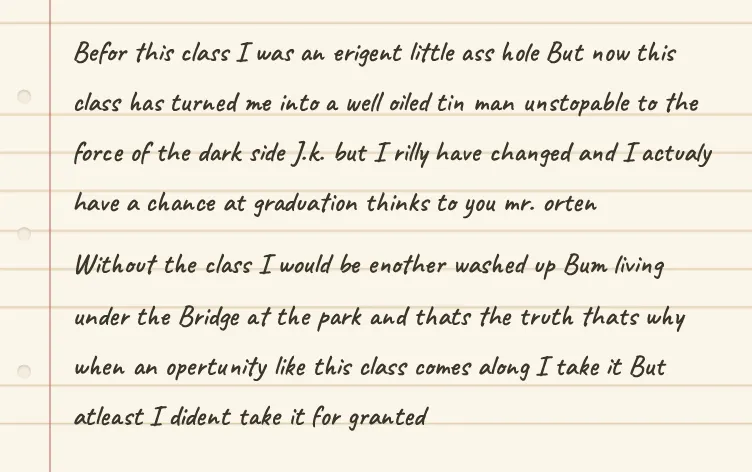
And here’s what still gets me every time I read it: he wrote this at the halfway mark. He had a whole year of growing still ahead of him.
And then, at the very bottom, the last line he left me:

I never did, Tim.
The kid who walked in with his arms folded, introducing himself as the worst thing anyone ever called him, wrote that. The armor was loud. The wish to be seen was louder. It always is. A person who has actually given up does not ask you to remember him.
You are not the story you got handed.
You never were. You’ve just hung onto it
the longest.
Time to write a different one.
— Bryan
If this was worth your time, it’ll be worth someone else’s. Send it to one person who needs it.
ONE MORE THING
Put Your AI to Work on This
You almost certainly have an AI on your phone or your laptop. Most people use it to write emails. Here’s a better use. Paste or attach this whole document, then give your AI the prompt below—and let it hold the lens up so you can finally see it.
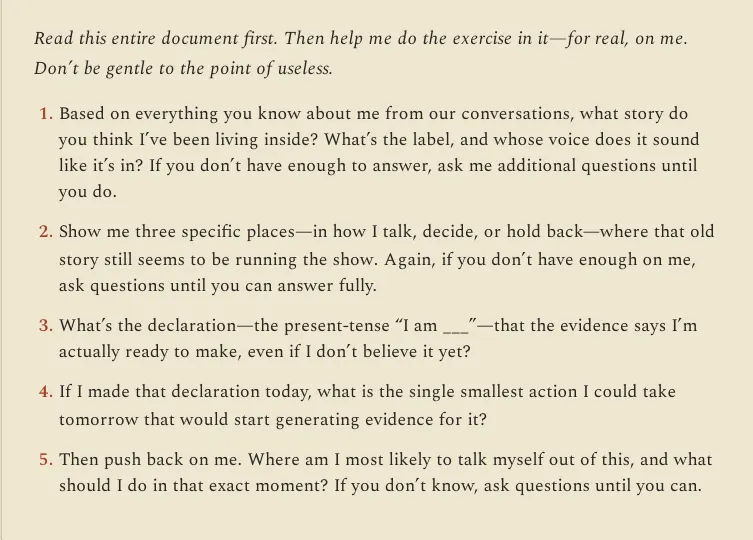
Don’t just read what it gives you. Argue with it. Correct it. The answer the AI hands you isn’t the point—the lens you finally get to see is.
THE FIRST LITERACY · BRYAN ORTON · BRYANORTON.COM